
LIC vs ETF: What investors need to know

This short technical guide is part of a series to help clients understand investment terms. Listed Investment Companies and Exchange Traded Funds are both traded on the ASX and can be useful parts of a diversified portfolio. Below, we explain, in plain English, what each structure is, how they behave in the market, and the main things investors need to know.
What is an LIC?
A Listed Investment Company, or LIC, is a company you buy shares in that owns a portfolio of investments, often Australian and global shares. When you buy a share in an LIC, you own a small piece of that company.
Think of an LIC as owning a share of an apartment building. The building earns rent, a manager looks after the property, and the income is shared with the owners. Because the number of apartments is fixed, the price to buy an apartment can be higher or lower than the building’s recorded value, depending on demand. In the same way, an LIC’s market price can trade at a premium or a discount to the value of the assets it holds.
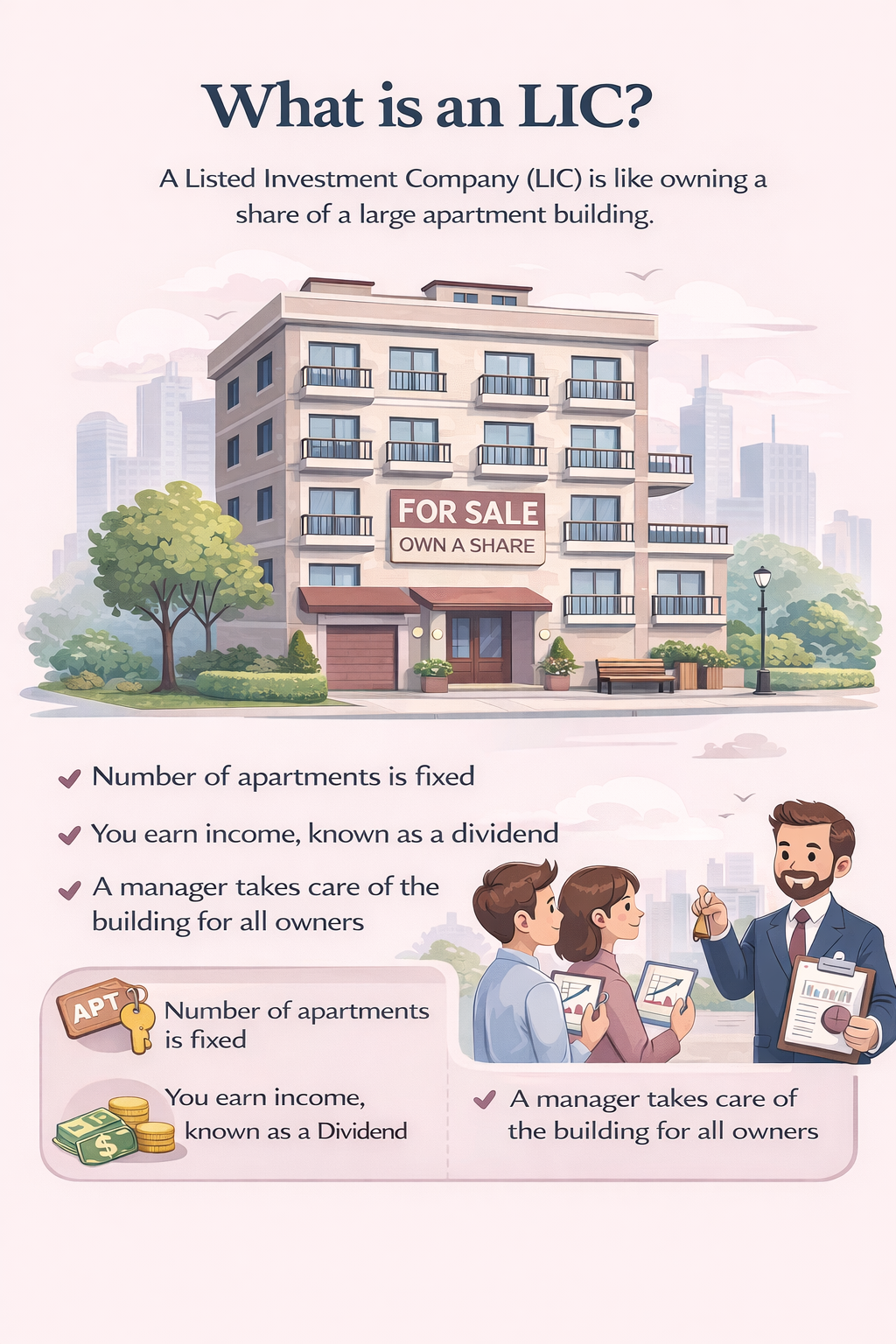
Key things investors need to know about LICs
You buy shares in the company.
LICs are usually actively managed, so a manager or team chooses the investments.
The market price can trade above or below the underlying value of the assets.
LICs commonly pay dividends, and many dividends are franked where company tax has already been paid.
Management costs tend to be higher for active LICs.
Liquidity can be lower than for some ETFs, so consider what the trading volume is, when buying or selling.
Takeaway: LICs suit investors who want an actively managed, income or value approach and understand that share price can move away from the underlying asset value.
What is an ETF?
An Exchange Traded Fund, or ETF, is a fund that issues units you buy on the stock market. The fund pools money from many investors and holds a basket of assets, such as shares, bonds or a mix of assets. Many ETFs track an index, while some are actively managed.
Think of an ETF as a fruit box subscription. If more people subscribe, the supplier makes more boxes. If fewer people subscribe, the supplier makes fewer boxes. The cost of each box stays very close to the value of the fruit inside, whether there are 10 or 100 subscribers. That is because ETF managers can create or redeem units to match demand, which helps keep the market price close to the fund’s net asset value.
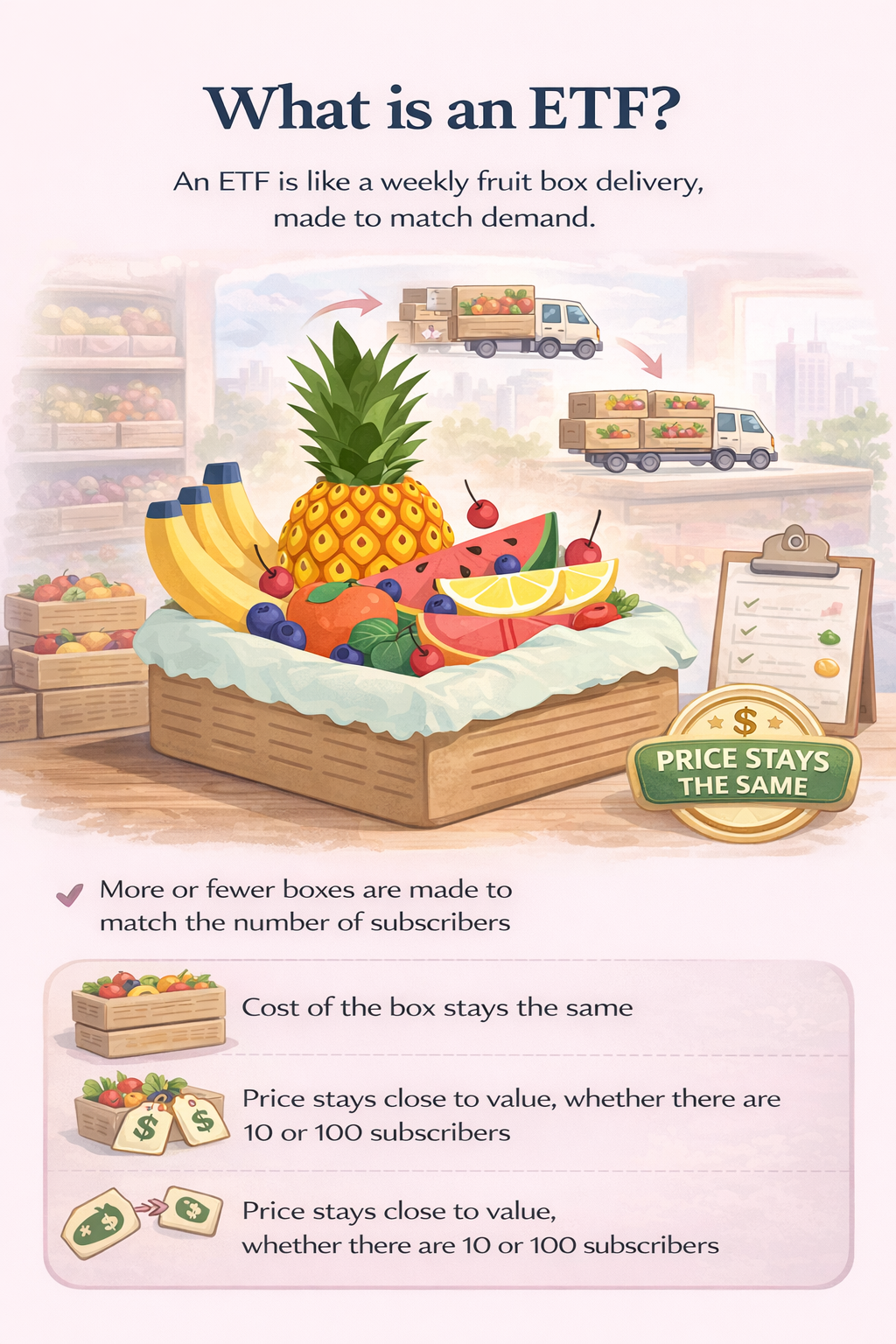
Key things investors need to know about ETFs
You buy units in the fund rather than company shares.
Many ETFs track an index, so they are lower cost than active funds.
Creation and redemption mechanisms mean ETF prices usually trade close to the value of what they hold.
ETFs pay distributions that can include income, capital gains and foreign income. Some ETFs pass through franking credits, but the tax reporting can differ from LIC dividends.
Things to look for in an ETF include the fees, the tracking method of the ETF and liquidity, especially for less common ETFs.
Takeaway: ETFs are often a low-cost way to get broad market exposure and tend to trade close to the value of their holdings because supply adjusts to demand.
In summary
LICs are shares in a company that actively manages investments. Their market price can trade above or below the value of the assets they own (think: an apartment building, where the buyer sets the value or purchase price they’re willing to pay for their unit, as there’s a limited number of properties to choose from).
ETFs are shares or units in a fund that usually track an index and are designed so unit prices stay close to the fund’s underlying value (think: fruit boxes where your subscription is based on the cost of the fruit and delivery, and providers can increase or reduce how many fruit boxes they offer based on demand).
Both structures can pay income (dividends) but have different tax implications and other considerations to compare.
General Advice Warning
The information in this presentation has been prepared for general information purposes only and does not consider your personal objectives, financial situation or needs. It is not intended to provide commercial, financial, investment, accounting, tax or legal advice. You should, before you make any decision regarding any information, strategies, or products mentioned in this email, consult a professional financial adviser to consider whether it is suitable and appropriate for you and your personal needs and circumstances. Before deciding to acquire a financial product, you should obtain and read the Product Disclosure Statement (PDS) relating to that product, together with the Target Market Determination (TMD).
Antoinette Mullins
GradDipFinPlan| CFP® | B.Diac | ADFS (FP)
Certified Financial Planner® & Director
Antoinette Mullins is an Authorised Representative (No. 316376) of Spark Advisors Australia Pty Ltd
ABN 34 122 486 935 AFSL 380552
Tanya Oddo
BA-BCom|DFP
Financial Planner & Director
Tanya Oddo is an Authorised Representative (No. 284500) of Spark Advisors Australia Pty Ltd